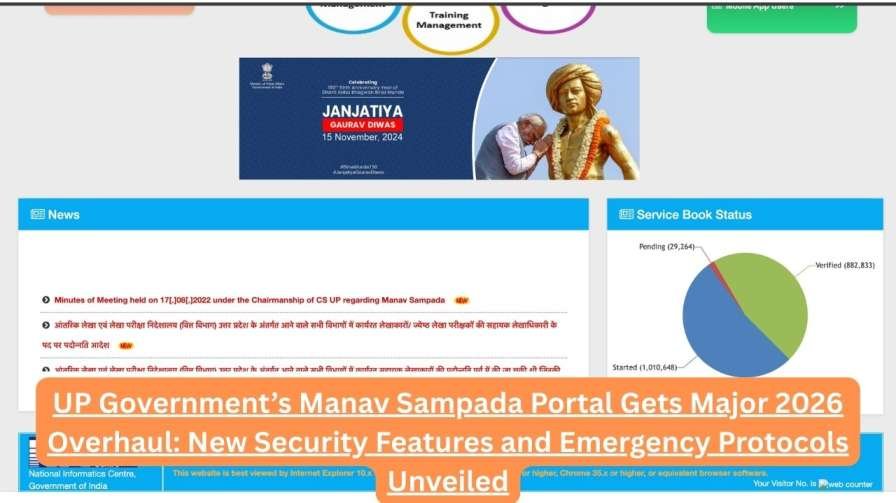
In a significant push towards complete digital governance, the Yogi Adityanath government has rolled out a comprehensive update to the Manav Sampada UP Portal (ehrms.upsdc.gov.in), the electronic HRMS backbone for over a million state employees. Effective immediately, the 2026 version introduces mandatory cybersecurity protocols, an emergency leave fast-track system, and enhanced mobile accessibility, fundamentally changing how the state’s workforce interacts with the administration.
Officials from the National Informatics Centre (NIC), the technical architects behind the portal, confirmed that the upgrades are designed to eliminate bureaucratic red tape while ensuring data integrity. For the vast network of Basic Education teachers, medical officers, and police personnel, mastering these new features is now a prerequisite for seamless service.
‘Zero-Tolerance’ Approach to Login Security
The most immediate change for employees is the fortified login process. Starting this year, the portal has implemented a mandatory password reset policy upon first access to comply with updated state cybersecurity laws.
To access their dashboards, employees must navigate to the and carefully select their specific department—such as EDUBASIC for primary teachers or MEDHLTH for healthcare staff—using the smart search tool. While the default password formula remains (first three uppercase letters of the first name combined with the last four Aadhaar digits), the system now forcibly requires users to create a complex password incorporating uppercase, lowercase, numbers, and special characters.
“We are moving toward a zero-tolerance policy for digital security loopholes,” stated a senior NIC officer involved in the project. “The forced password change ensures that basic credentials are not left vulnerable.”
Emergency Leave Gets ‘Auto-Approval’
In a move aimed at boosting employee morale and addressing ground-level realities, the 2026 leave module now includes a “Medical Emergency/Unforeseen Circumstances” feature. Citing a recent amendment to service rules, the portal now grants provisional auto-approval for leaves up to 96 hours in genuine emergencies.
Employees selecting this checkbox will receive immediate relief, but they must regularize the absence by uploading supporting documents, such as digitally signed medical certificates, within five working days via the new “Regularize Emergency Leave” sub-module. Standard leave applications for Earned Leave or Child Care Leave continue to require prior document uploads, including birth certificates for CCL.
Teacher-Centric Features Take Center Stage
Given that educators form the largest user demographic, the portal’s update places a heavy emphasis on the Basic Education department.
The digital e-Service Book for teachers now includes a “Verification Log,” allowing users to see exactly who accessed their service records and when—a feature aimed at increasing transparency in postings and promotions. Furthermore, the m-STHAPANA 2.0 mobile app has been upgraded with biometric login, enabling teachers in remote locations to apply for transfers, check seniority points, and download salary slips directly onto their smartphones.
“Earlier, we had to visit the block office for simple salary slip queries. Now, even the emergency leave gets approved on my phone within minutes,” said a primary school teacher from Lucknow, testing the new app features.
Accessing Salary Slips and Annual Compliance
With the income tax filing season underway, the Payroll section remains a critical access point. Employees can download password-protected salary slips by navigating to ‘Employee Services’ and selecting the financial year. The password is typically the 8-digit Employee ID or Aadhaar number.
The government has also issued a strict reminder regarding Annual Property Returns. The portal now features a dedicated “Compliance” section where returns must be filed by December 31st. Official sources warn that late filing will attract adverse remarks in service records.